
Critical and Decolonial Approaches Seminar (Online)
Registration https://biea.ac.uk/leveraging-climate-finance-access
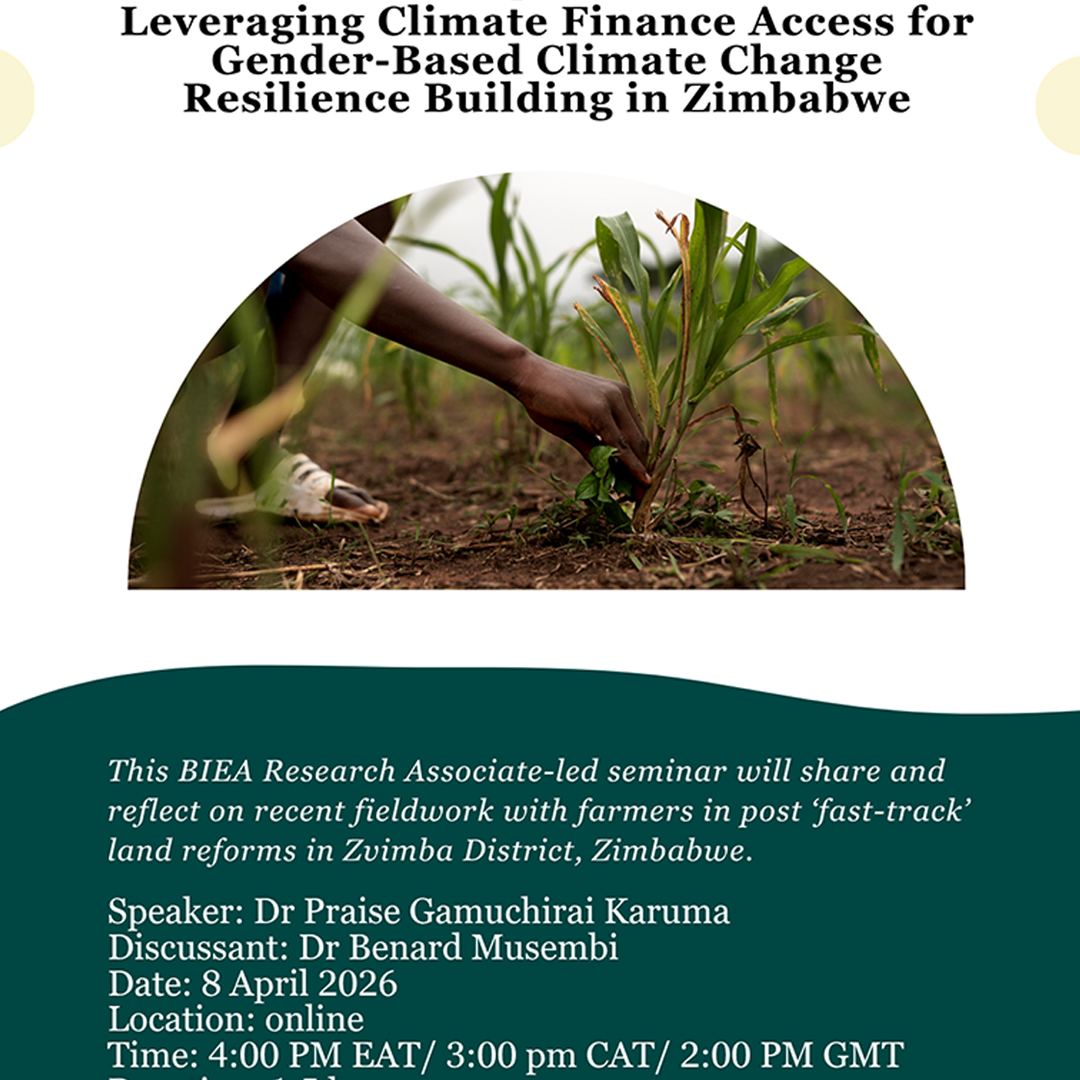
Leveraging Climate Finance Access for Gender-Based Climate Change Resilience Building in Post Fast-Track Farms in Zvimba District, Zimbabwe.
The climate finance system acts as an essential tool which help communities develop strength against climate change impacts, yet the distribution of funding remains highly unequal across different populations. Developing nations should receive USD 100 billion annually according to international agreements but sub-Saharan Africa particularly suffers from receiving only a small portion of worldwide climate finance which has been allocated to developing countries (Buchner et al., 2019; Atteridge & Strambo, 2020). The post-Fast Track Land Reform Programme (FTLRP) farming communities in Zimbabwe experience intensified climate finance exclusion because their land tenure systems face political scrutiny and they have been pushed to the edges of institutional processes while they lack access to official banking networks (Jakarasi, 2022; Tinarwo & Dzamwanda, 2024; Hlatshwayo & Mpundu, 2024). The research assessed how climate finance functions to strengthen gender-based resilience efforts within post-FTLRP communities in Zvimba District, Mashonaland West Province, Zimbabwe. The researcher used sequential exploratory mixed-methods design to conduct a study which integrated structured mini-survey (n=186) and key informant interviews (n=18) and focus group discussions (n=6) and field observations across three selected wards through Feminist Political Ecology and the Sustainable Livelihoods Framework. The study found that 68.3% of participants had obtained some type of climate finance while women experienced 14.9 percentage points lower success rate than men in securing funding. Accessing the services became difficult for most women on the farms (87%) because they lacked bankable land title according to while 79.6% of the female respondents faced challenges with information gaps 74% of the participants also encountered difficulties because of their family members’ preferences. The research found that gender-based indigenous knowledge systems and community-led innovations especially Village Savings and Loan Associations (VSLAs) function as fundamental local systems which can enhance resilience through formal climate finance delivery systems. The research results demonstrate that Zimbabwe requires gender-responsive criteria for national climate finance eligibility while it should recognize offer letters as financial guarantees and use informal savings networks for climate finance distribution at the final delivery stage. The study developed a Gender-Responsive Climate Finance Resilience Model (GRCFRM) which provides a location-based analysis and program framework designed to help PFTLRP locations access climate finance. The study shows that gender-responsive climate finance functions is an essential requirement for equity, yet it also serves as an indispensable requirement for development efficiency which establishes effective climate resilience in Zimbabwe’s resettlement areas. Keywords: climate finance, gender resilience, post-FTLRP, Zvimba District, Zimbabwe, adaptive capacity, gender-responsive development
About the Speaker
Dr. Praise Gamuchirai Karuma is a Postdoctoral Research Fellow at the University of South Africa (UNISA), College of Graduate Studies, School of Trans-Disciplinary Research and Graduate Studies (STRGS) and a lecturer in Community and Social Development at the University of Zimbabwe. He holds a PhD in Anthropology (Development Studies) from the University of Pretoria, and an MSc and BSc Honours in Sociology from the University of Zimbabwe. With over eight years of academic experience, Dr. Karuma has worked for various academic institutions in Zimbabwe and coordinated development projects for international organizations including FAO, UNDP, and PLAN International together with also serving government entities such as the Parliament of Zimbabwe as a consultant. His research interests include climate change and resilience, sport sociology, rural and urban livelihoods, poverty, urbanization, gender and sustainable development, and project evaluation. He has published extensively in peer-reviewed journals and book chapters on climate resilience, urban development, gender dynamics, and sport in Zimbabwe, employing interdisciplinary ethnographic and quantitative methodologies to address contemporary Southern African development challenges.


