
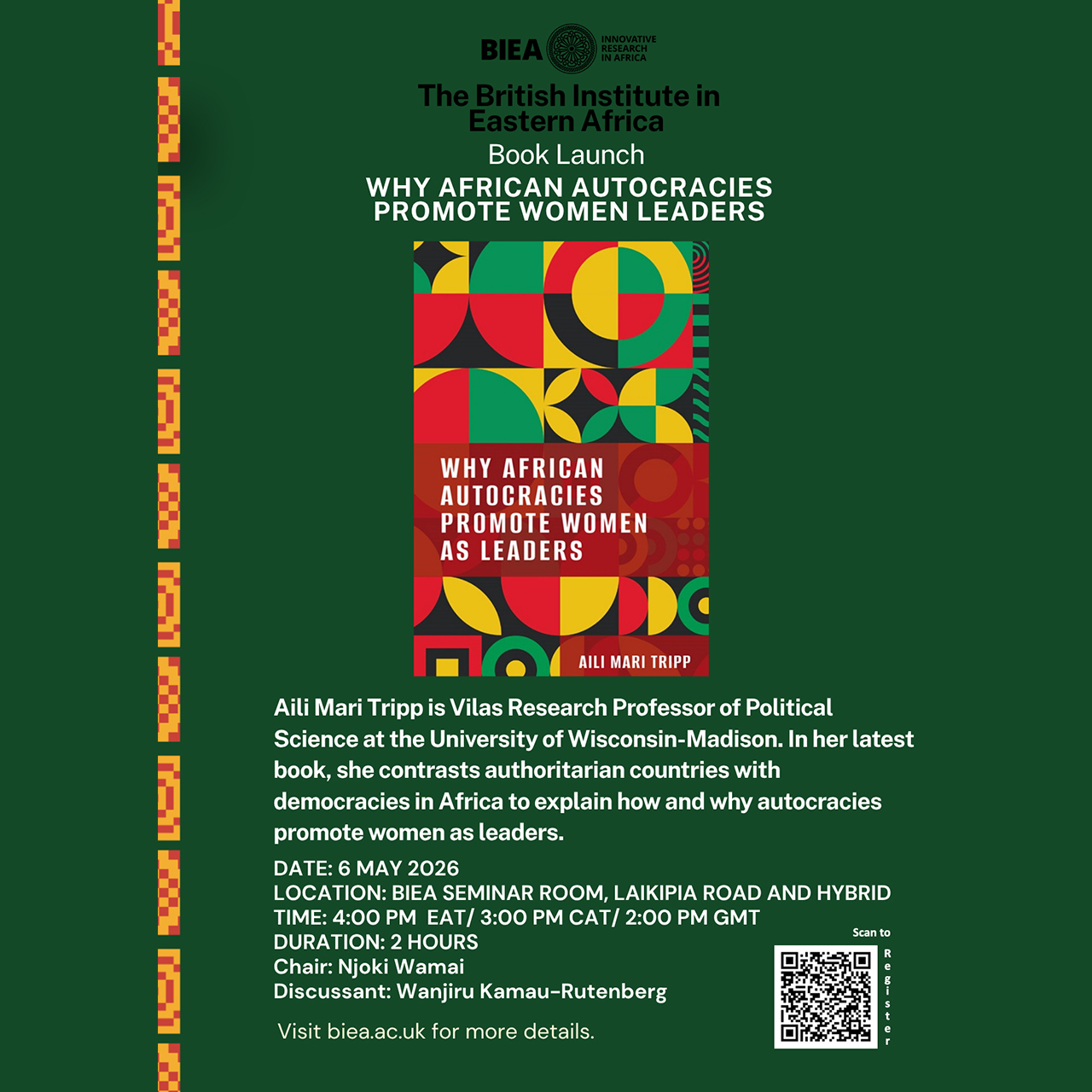
Book Launch: Why African Autocracies Promote Women as Leaders
Why African Autocracies Promote Women as Leaders (Oxford University Press, 2025) by AiliMari Tripp contrasts authoritarian countries with democracies in Africa to explain how and why autocracies promote women as leaders. The face of African politics has changed significantly since the mid-1990s as more women have entered politics in both democracies and autocracies. Women’s movements and organizations have successfully lobbied for and won more leadership roles for women in the executive, legislature, and sub-national bodies. At the same time, in authoritarian countries this has created a conundrum: these successes in attaining leadership roles for women potentially end up strengthening the very regime that violates human and women’s rights. These regimes instrumentalize women leaders and women’s rights to enhance the longevity of an autocratic ruling party by increasing vote share, enhancing internal and external legitimacy, and softening their image after civil war, jihadist activity, or military rule. This occurred in the context of the shift from one-party to multiparty states, the end of major conflicts, and changing international gender norms in the 1990s. The study draws on cross-national research in Africa and over 188 in-depth interviews in Uganda, Rwanda, Zimbabwe, Mauritania, Morocco, and in two democracies, Namibia and Botswana.
Speaker: Aili Mari Tripp is Vilas Research Professor of Political Science at the University of Wisconsin-Madison. Her research has focused on gender/women and politics, women’s movements in Africa, transnational feminism, authoritarian politics in Africa, and the informal economy in Africa. She is author of Why African Autocracies Promote Women as Leaders (Oxford University Press, 2025) and several award-winning books, including Seeking Legitimacy: Why Arab Autocracies Adopt Women’s Rights (2019), Women and Power in Postconflict Africa (2015), African Women’s Movements: Transforming Political Landscapes (2009) with Isabel Casimiro, Joy Kwesiga, and Alice Mungwa, and Women and Politics in Uganda (2000). She has served as the President of African Studies Association, Vice President of the American Political Science Association, and a co-editor of the American Political Science Review.
Chair: Dr. Njoki Wamai is an Assistant Professor at USIU, Africa. She is a University of Cambridge trained academic, researcher, gender, governance, peacebuilding and transitional justice consultant and feminist activist interested in locating political realities that emerge at the everyday level in African contexts in the academy and research.
Discussant: Dr. Wanjiru Kamau-Rutenberg is the Africa Managing Director for the Alliance of Bioversity International and CIAT. She recently was a Senior Fellow at the Ford Foundation and Executive Director of Black Women in Executive Leadership (B-WEL) where she remains Founder and President.


