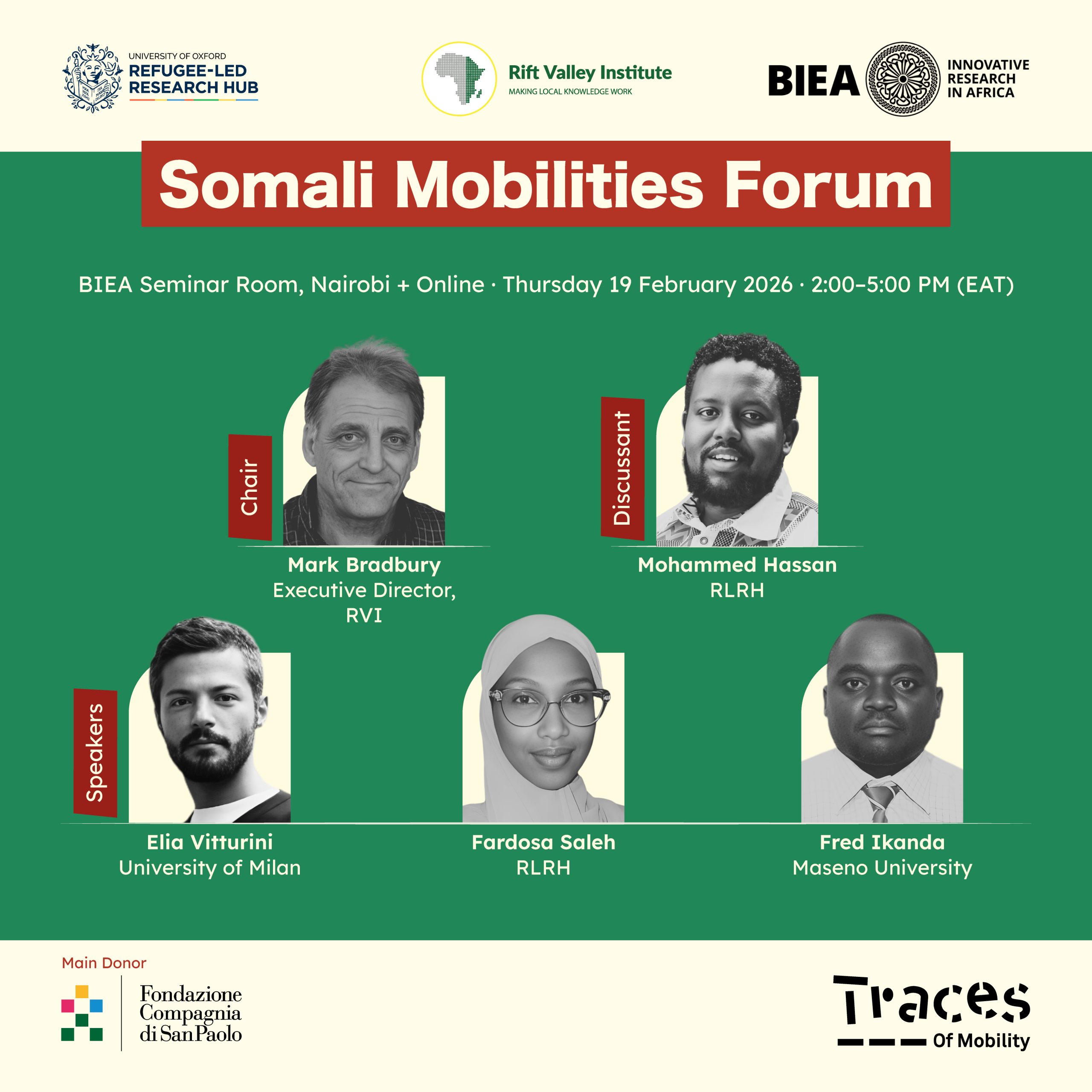
Somali Mobilities Forum
This hybrid event brings together scholars and practitioners to explore whether and how Somali experiences of mobility are changing. It will examine the contemporary forms and historical continuities of displacement and violence, including how Somalis are classified and treated amid heightened hostility and discrimination towards migrants and refugees and declining humanitarian support. It will also consider the agency and strategies—such as local solidarities, legal advocacy, protests and policy initiatives—through which Somali communities and their allies are responding. It will reflect upon the relationships and differences among Somalis, and how their experiences vary with attention to gender, generational, class and clan identities. The forum will share insights from previous or ongoing research, and to foster networks and ideas to inform future research and policy agendas.Participants
Chair: Mark Bradbury, RVI; discussant Mohammed Hassan, RLRH
Speakers
- Elia Vitturini, University of Milan: ‘Changing Somali networks and institutions under conditions of mobility, violence and precarity in Italy’
- Fardosa Saleh, Refugee-led Research Hub: ‘From ‘refugee’ to ‘new arrival’: The challenges faced by repatriated Somali refugees returning to Dadaab’
- Fred Ikanda, Maseno University: ‘The Securitization of Somali Refugees’
Click here for the Event Programme
To join remotely: https://us06web.zoom.us/j/87029814100?
Meeting ID: 870 2981 4100
Passcode: welC0ME
Bios
Elia Vitturini is a postdoctoral fellow on Traces of Mobility, Violence and Solidarity: Rethinking heritage through the lens of migration at the University of Milan. In 2017, he received his PhD in social anthropology at the University of Milan-Bicocca. His research experience started in 2011 in Main donor Somaliland, where he studied the local political arena, youth activism, political party members, their participation in electoral campaign and the state-building process in the Republic of Somaliland. During his PhD, he expanded his research interests to the study of marginalised minorities and the ascribed status groups of occupational specialists in Somaliland. He conducted a historical-ethnographic investigation on social stratification and emancipation dynamics in the Somali territories. In 2019 he began working on the social networking practices of Somali migrants in Italy.
Fardosa Salah is currently a Research Officer at the Refugee-Led Research Hub (RLRH), based in Nairobi, Kenya. Prior to joining the RLRH through the 2021–22 RSC-BIEA Fellowship, Fardosa was a community case worker and paralegal interpreter for six years. She worked with HIAS Refugee Trust of Kenya implementing urban refugee assistance programmes where she supported programmes on sexual and genderbased violence (SGBV) prevention and response. She also worked with non-governmental organisation Kituo cha Sheria as a paralegal interpreter to provide legal advice and representation to refugees and asylum seekers in Kenya. She graduated from the University of Nairobi with a double BA in Sociology and Social work, and Peace and Conflict studies.
Fred Ikanda is a Senior Lecturer in the Department of Sociology and Anthropology at Maseno University. He is a holder of a PhD in Social Anthropology from the University of Cambridge and has published widely on refugee and forced migration issues. His doctoral research focused on how kinship sustains the continued existence of the Dadaab camps in northeastern Kenya. His current research focuses on a number of issues, including forced migration, social cohesion, gender relations, ethnography of bureaucracy, hospitality in refugee settings, vulnerable livelihoods, social resilience, kinship, and contested ideas of Islam.
Mohamed Hassan Mohamud is a refugee researcher and practitioner with over 20 years of lived experience in Kakuma Refugee Camp, Kenya. He is a Research Officer at the Refugee-Led Research Hub in Nairobi, where his work focuses on bridging the gap between policy and practice through contextually grounded, locally generated evidence. Mohamed was elected as a zonal chairperson in Kakuma, advocating for refugee rights and governance, and later became the first refugee UN Volunteer in East and Sub-Saharan Africa. In that role, he co-developed the Kalobeyei Constitution and supported elections for village and neighbourhood refugee leaders in Kalobeyei settlement. An alumnus of the Oxford-BIEA Fellowship (2021–22), Mohamed has also studied with Princeton University’s Global History Lab and the Open Society University Network’s Oral History and Literature programme. He has spoken at global platforms, including the African Union and the World Economic Forum in Davos. His expertise includes refugee participation, localisation, economic inclusion, and complementary pathways, with a commitment to advancing meaningful refugee leadership, accountability in humanitarian governance, and pathways to durable solutions.
Mark Bradbury is the Executive Director of the Rift Valley Institute. A social analyst and development practitioner, he has worked in and written about Somalia, Somaliland, Sudan, South Sudan, Sierra Leone, Kenya, Uganda, and Kosovo. He is author of Becoming Somaliland (2008).


